
Quick Answer
For most Miami homes, remodeling costs 20–50% less than tearing down and rebuilding when the foundation, framing, and roof structure are sound. A full Miami remodel runs roughly $100–$250+ per square foot (mid-range around $175/sq ft), while a teardown-and-rebuild runs $200–$500+ per square foot plus $8,000–$25,000 for demolition. But the moment your home has serious structural damage, failing systems, an unfixable layout — or your renovation triggers the FEMA 50% rule in a flood zone — rebuilding often becomes the more rational path. The deciding factors are the home’s condition, your flood-zone status, and how much of the structure is worth saving.
What you’ll learn in this guide
This is a decision framework, not a sales pitch. By the end you’ll be able to weigh your own home against the same criteria a structural engineer uses, and you’ll understand the cost, timeline, and regulatory realities specific to South Florida.
We cover the real per-square-foot numbers for both paths, the structural and financial triggers that point toward one option over the other, the FEMA 50% rule that reshapes flood-zone projects, permit and timeline expectations in Miami-Dade, and how to get a real answer for your specific property before you commit a dollar.
The real 2026 numbers: remodel vs. rebuild
Square-foot pricing is the starting point, not the final word — but it frames the decision honestly. Here are the current ranges for South Florida.
| Path | Cost / Sq Ft (2026) | What’s Included | Typical 2,500 sq ft Home |
|---|---|---|---|
| Cosmetic remode | $60–$100 | Finishes, paint, fixtures, light updates | $150K – $250K |
| Full / gut remodel | $100–$250+ | Upgraded finishes, more architectural detail, better sNew systems, layout changes, kitchen & baths | $250K – $625K |
| Major remodel + addition | $175–$300+ | Gut plus added square footage, structural work | $440K – $750K+ |
| Teardown + rebuild | $200–$500+ | Demolition, new foundation, full custom build | $500K – $1.25M |
Demolition alone adds $8,000–$25,000 for a single-family home, including debris removal and permits. Wet rooms drive remodel budgets fastest: kitchens and bathrooms run $100–$250 per square foot on their own.
The rule of thumb: a whole-house remodel is typically 20% to 50% cheaper than tearing down and building new — as long as the bones are good. When the foundation, plumbing, electrical, or HVAC are failing, that math flips, because you end up paying to work around problems a new build would simply eliminate
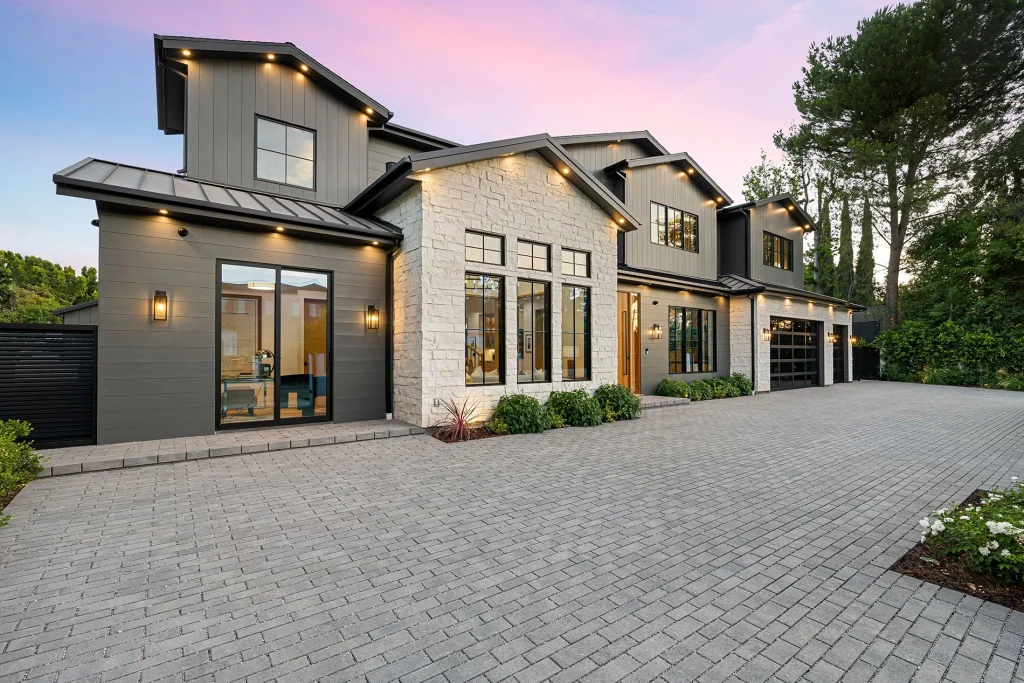
When remodeling is the right call
Remodeling wins when what you have is fundamentally sound and the problem is design, finishes, or function — not structure.
Lean toward a remodel when your foundation, framing, and roof structure are in good condition and inspect clean. The same is true when your goal is to modernize layouts, upgrade finishes, improve energy efficiency, or refresh curb appeal without changing the building’s footprint or core systems. Remodels also win on speed: many are completed in a few months rather than the year-plus a custom rebuild takes. And if you’re staying well under the flood-zone improvement threshold, you avoid an entire layer of compliance cost. In short, if the house is worth saving and you mostly want it to look and work differently, remodeling is usually the smarter spend.
When tearing down and rebuilding makes more sense
A teardown-and-rebuild becomes the rational choice when the existing structure is fighting you at every turn.
Rebuilding tends to win when the home has severe structural damage, a compromised foundation, or systems so outdated that repairing them costs more than replacing them. It’s also the better path when the layout simply can’t be fixed through remodeling — when no amount of wall-moving gives you the home you actually need. A widely used financial trigger: when the cost of renovating exceeds roughly 50% of the home’s market value, a rebuild often makes more sense, because you’re pouring serious money into an old shell instead of a new one. Rebuilding also gives you a blank slate — a fully custom home designed to current hurricane and energy codes from day one — at the cost of a longer timeline and a stricter permitting process.
There’s also a market reality in established Miami-Dade neighborhoods: in areas like Coral Gables, South Miami, Pinecrest, and Glenvar Heights, much of the housing stock was built between the 1950s and 1970s — great lots and locations, dated homes. When unrenovated homes trade well below new-construction value per square foot, the teardown math works because the lot justifies the investment. That’s part of why Miami-Dade issued over 1,500 new residential building permits through Q3 2025, up sharply year over year.
The FEMA 50% rule: the trigger most homeowners miss
This is the part that catches Miami homeowners off guard, and it can reshape your entire project. If your home is in a Special Flood Hazard Area — common across coastal and low-lying Miami-Dade — the FEMA “Substantial Improvement” rule applies.
Here’s the rule in plain terms: if the cost of your renovation or repair equals or exceeds 50% of your home’s pre-improvement market value (the structure only, not the land), the entire home must be brought into compliance with current floodplain regulations. In practice that can mean elevating the structure to Base Flood Elevation, upgrading systems, and using flood-resistant materials — regardless of what your renovation was actually for.
A few things make this rule especially important to plan around:
- It’s the structure’s value, not the land. The calculation compares your project cost to the building’s value alone — and in Miami, land is often the most valuable part, so the structure value can be lower than owners expect, making 50% easier to hit.
- What you’re renovating doesn’t matter. A kitchen, a second story, or a full interior redesign all count the same way once total project cost crosses the threshold.
- Both labor and materials count — generally including overhead and profit — toward the 50% calculation.
- Non-compliance has teeth. It can mean denied permits, construction delays, and a home that can’t be properly insured.
The practical takeaway: if you’re in a flood zone and planning a major renovation, get a proper structure valuation and talk to a design-build professional before you finalize your scope and budget. Discovering the 50% rule after the numbers are set is how renovation budgets blow up — and it’s often the point where a rebuild quietly becomes the better financial decision anyway.
What it costs in permits and how long it takes
Both paths run through Miami-Dade permitting, and the timelines differ with scope. As of October 2025, Miami-Dade residential permits run 0.5% of projected construction cost — the county’s first fee increase in over 17 years. Separate trade permits for electrical, mechanical, and plumbing start at $166.63 each. Simple projects can clear permitting in about two weeks and finish in one to two months. Complex remodels often take 6–8 weeks for permits, then another 3–6 months of construction. A full custom rebuild runs longer still — generally 12 to 24 months from first design meeting to move-in, with hurricane season (June–November) capable of adding delays.
How long does each path take?
| Path | Permitting | Construction | Total (typical) |
|---|---|---|---|
| Cosmetic remodel | 2 weeks | 1–2 months | 1–3 months |
| Full / gut remodel | 6–8 weeks | 3–6 months | 5–8 months |
| Teardown + rebuild | 2–4 month | 10–16 months | 12–24 months |
The single biggest schedule variable is scope clarity. Projects that go to permit with complete, well-defined drawings move; projects built on vague assumptions stall in plan review and rack up change orders.

So how do you actually decide?
Strip away the noise and the decision comes down to four questions, in order.
First: what’s the condition of the structure? A professional structural inspection of the foundation, framing, and roof is the honest starting point — it tells you whether you’re saving a sound home or propping up a failing one. Second: are you in a flood zone, and will your project cross the FEMA 50% threshold? That single answer can change everything downstream. Third: what’s the renovation cost as a share of the home’s value? Above ~50%, a rebuild deserves serious consideration. Fourth: what do you actually want long-term — a refreshed version of this house, or a fully custom home designed to your exact needs and current codes?
Answer those four honestly and the right path usually becomes obvious. The mistake is setting a budget before you’ve answered them.
Frequently asked questions
Is it cheaper to remodel or rebuild a house in Miami?
What is the FEMA 50% rule in Miami-Dade?
When should I tear down instead of renovate?
How much does it cost to demolish a house in Miami?
How long does a teardown and rebuild take in Miami?
Does a remodel or rebuild add more value to my home?
The Next Step
Find out which path is right for your home
The honest answer to “remodel or rebuild?” starts with looking at your actual home — its structure, its flood-zone status, and your goals. A Concept Design Consultation with Ozzy and Miguel gives you a structural engineer’s read on what’s worth saving, the FEMA and permit realities for your lot, and a real preliminary budget for both paths.
We take a select number of projects each year. If you’re ready to stop waiting and start building, we want to hear from you.
Or call Miguel directly: (305) 968-1739
Ozzy’s Golden Construction · Boutique design-build firm serving Miami-Dade & Broward County since 2007 · 6955 NW 77th Avenue, Suite 308, Miami, FL 33166
This guide reflects 2026 South Florida construction market conditions and Ozzy’s Golden Construction’s direct project experience. Actual costs vary by project. Figures are for planning purposes and do not constitute a formal quote.