Quick Answer
Custom homes in Miami-Dade must be built to High-Velocity Hurricane Zone (HVHZ) standards — the toughest in the country — designed to withstand wind speeds of roughly 175+ mph. Unlike the rest of Florida, HVHZ rules require the entire building envelope (not just windows) to resist wind-borne debris, using impact-rated windows and doors carrying a Miami-Dade Notice of Acceptance (NOA), reinforced roofs, and a continuous load path of metal connectors tying roof to walls to foundation. Beyond safety, compliant hurricane features can cut the windstorm portion of your insurance by 10–45% under Florida law. The result is a home engineered to survive the storm and cost less to insure.
Why Miami has the strictest code in the country
This all traces back to one storm. When Hurricane Andrew hit South Florida in 1992, it caused over $26 billion in damage and exposed how poorly homes were built for the threat. The response was the Florida Building Code, first implemented in 2002 and updated every three years since. Miami-Dade and Broward went further, creating the High-Velocity Hurricane Zone (HVHZ) — provisions that apply only to these two counties and remain the only code in the nation requiring impact resistance across the entire building envelope, not just glazed openings.
The practical meaning for you: a custom home in Miami is held to a standard most of the country never sees. That’s a cost during construction — and a powerful advantage when the next storm comes and when you sell.
What makes a home truly hurricane-resistant
Hurricane resistance isn’t one feature; it’s a system where every part reinforces the others. A weak link anywhere lowers the whole home’s failure threshold. Here are the elements that matter most.
1.Impact-rated windows and doors (whole-envelope protection)
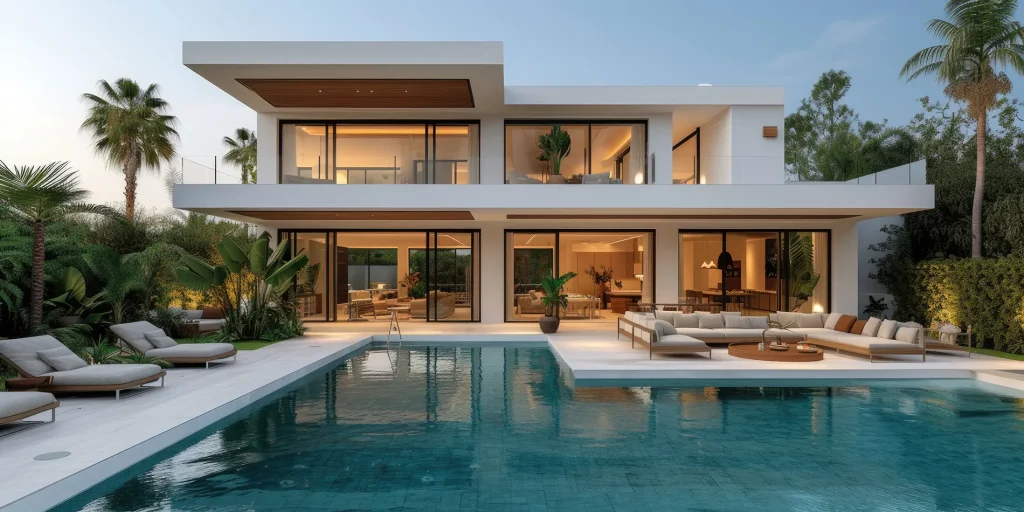
In the HVHZ, every glazed opening — windows, doors, skylights — must be impact-rated and pass the Large Missile Impact test plus extreme cyclic-pressure testing. Each product must carry a Miami-Dade Notice of Acceptance (NOA) or Florida Product Approval proving it was tested for these conditions. This matters because a single breached opening lets wind pressure build inside the home, dramatically increasing the uplift forces trying to tear the roof off. Protecting the whole envelope keeps the house sealed and intact.
2.A continuous load path
This is the structural backbone of hurricane resistance. A continuous load path is an unbroken chain of reinforced connections — metal straps, anchors, and ties — linking the roof to the walls to the foundation, so wind forces transfer safely down into the ground instead of ripping components apart. When you hear an engineer talk about “tying the house together,” this is it. It’s invisible in the finished home but it’s what holds everything together at 150 mph.
3.A wind-resistant roof
Roofs take the worst of a hurricane’s uplift. Code-compliant roofs use specific fastening systems, adhesives, and underlayments to resist failure, and hip roof designs (sloped on all four sides) consistently outperform gable roofs against hurricane winds. Secondary water resistance — a sealed barrier beneath the roof covering — keeps water out even if the outer layer is damaged.
4.Reinforced concrete construction and openings
Many high-end Miami homes use reinforced concrete or concrete block for the structure, paired with heavy-duty doors with multi-point locks and reinforced garage doors. The garage door is a commonly overlooked weak point: if it fails under pressure, the entire envelope can be compromised, so HVHZ-rated garage doors are essential.
5.Elevation and flood resistance
Wind is only half the threat — storm surge is the other. Custom homes in flood-prone areas are elevated to or above Base Flood Elevation and use flood-resistant materials at lower levels. With the upcoming Florida Building Code 9th Edition (effective December 31, 2026) expected to add enhanced flood-resistant requirements in surge zones, building with elevation in mind now is future-proofing.
The insurance payoff: how hurricane features lower your premium
Here’s what many homeowners don’t realize: building hurricane-resistant doesn’t just protect you — Florida law requires insurers to reward it.
Under Florida Statute §627.0629, every homeowners insurance carrier must offer premium discounts for verified wind-mitigation features, and opening protection is one of the highest-value credits available. In practice, documented impact-rated protection can reduce the windstorm portion of your premium by 10–45%, commonly worth $400–$3,200 per year in South Florida depending on coverage. When every wind-mitigation category is maximized, the total windstorm discount can reach 85–90%.
The critical catch
The discount isn’t automatic. You must have a certified wind-mitigation inspection documented on Florida’s Uniform Mitigation Verification Inspection Form (OIR-B1-1802) — updated effective April 2026 — and submit it to your insurer with the product approvals (NOAs) and permits. Build it right, document it properly, and the savings are mandated by law, not left to the insurer’s discretion.
There’s help with the cost, too: the My Safe Florida Home program offers free wind-mitigation inspections and matching grants (up to $10,000, on a 2:1 state match) for qualifying upgrades like impact windows and doors.
What hurricane-resistant features cost
Resilience is an investment, and the ranges are worth knowing as you budget. Impact windows are the most common line item homeowners ask about.
| Build Tier | Cost / Sq Ft (2026) | What You Get | 3,500 sq ft |
|---|---|---|---|
| Quality custom (entry) | $400–$580 | Custom layout, solid finishes, standard impact-rated glazing | $1.4M – $2.0M |
| Mid-range custom | $650–$750 | Upgraded finishes, more architectural detail, better systems | $2.3M – $2.6M |
| Luxury custom | $800–$1,000+ | Fully custom architecture, premium structural systems, custom millwork, impact glazing throughout | $2.8M – $3.5M+ |
| Waterfront / ultra-estate | $1,100–$3,200+ | Barrier-island construction, elevated foundations, deepest customization and automation | $3.9M – $11M+ |
In a ground-up custom home, hurricane-resistant construction is integrated into the design and structure rather than added later — which is both more effective and more economical than retrofitting an older house. That’s the advantage of building new in Miami: resilience is engineered in from day one.
Building new vs. retrofitting an older Miami home
If you already own an older South Florida home, you can retrofit — impact windows, stronger roof connections, reinforced doors — to improve resistance and qualify for insurance credits. But retrofitting works around an existing structure that may predate modern code.
A new custom home lets a structural engineer design the entire load path, envelope, and elevation as one integrated system built to current HVHZ standards. You get maximum protection, the full insurance benefit, and no compromises forced by an old foundation or framing. For many homeowners weighing a major renovation against a rebuild, the hurricane-resistance gap between “improved” and “engineered from scratch” is part of what tips the decision.
Frequently asked questions
What wind speed must Miami homes be built to withstand?
What is the HVHZ (High-Velocity Hurricane Zone)?
Are impact windows required in Miami?
Do hurricane-resistant features lower my insurance?
What is a continuous load path?
The Next Step
Build a home engineered for the storm
In Miami, the difference between a home that weathers a hurricane and one that doesn’t comes down to engineering decisions made long before the first wall goes up — the load path, the envelope, the elevation, the products and their documentation. In a Concept Design Consultation, Ozzy can walk you through what HVHZ compliance means for your specific lot, how to maximize both protection and insurance savings, and what it takes to build a custom home engineered for South Florida’s climate from the foundation up.
We take a select number of projects each year. If you’re ready to stop waiting and start building, we want to hear from you.
Or call Miguel directly: (305) 968-1739
Ozzy’s Golden Construction · Boutique design-build firm serving Miami-Dade & Broward County since 2007 · 6955 NW 77th Avenue, Suite 308, Miami, FL 33166
This article reflects 2026 Florida Building Code and HVHZ requirements and Ozzy’s Golden Construction’s direct project experience. Codes, costs, and insurance rules change; verify current requirements for your specific project.